
Published: August 2026 | Category: Neurological & Brain Health Research
Reviewed Evidence
Reviewed Study 1: Efficacy of Intrathecal Mesenchymal Stem Cell-Neural Progenitor Therapy in Progressive MS: Results From a Phase II, Randomized, Placebo-Controlled Clinical Trial
Authors: Harris VK, Stark J, Williams A, et al.
Publication & Date: Stem Cell Research & Therapy. 2024;15:151.
DOI / Link: https://doi.org/10.1186/s13287-024-03765-6 | PubMed
Reviewed Study 2: Mesenchymal Stromal-Cell Transplants Induce Oligodendrocyte Progenitor Migration and Remyelination in a Chronic Demyelination Model
Authors: Jaramillo-Merchán J, Jones J, Ivorra JL, et al.
Publication & Date: Cell Death & Disease. 2013;4:e779.
DOI / Link: https://doi.org/10.1038/cddis.2013.304 | PubMed
Reviewed Study 3: Allogeneic Bone Marrow-Derived Mesenchymal Stem Cells for Parkinson’s Disease: A Randomized Trial
Authors: Schiess MC, Suescun J, Martinez-Lemus JD, et al.
Publication & Date: Movement Disorders. 2025;40(12):2688-2699.
DOI / Link: https://doi.org/10.1002/mds.70028 | PubMed
Reviewed Study 4: Bone Marrow Mesenchymal Stem Cells’ Secretome Exerts Neuroprotective Effects in a Parkinson’s Disease Rat Model
Authors: Mendes-Pinheiro B, Anjo SI, Manadas B, et al.
Publication & Date: Frontiers in Bioengineering and Biotechnology. 2019;7:294.
DOI / Link: https://doi.org/10.3389/fbioe.2019.00294 | PubMed
Scientific Review By: Michael Healey, M.Ed., C.A.S.
Executive Summary & Key Takeaways
Primary Objective: Evaluate whether mesenchymal stromal cell (MSC) signaling supports myelin repair or protects nerve cells in multiple sclerosis (MS) and Parkinson’s disease.
Mechanism Evaluated: MSCs may release proteins and tiny cell particles that help regulate inflammation and signal the brain’s existing repair cells.
Key Finding: Animal studies provide evidence of remyelination and protection of cells associated with dopamine production. Human trials have not shown that MSCs directly repair myelin or restore dopamine-producing neurons.
Clinical Significance: The MS trial did not meet its primary endpoint. Some Parkinson’s patients met the study’s definition of improvement, but patients receiving placebo improved nearly as much, and results were inconsistent across treatment groups.
Study Overview & Clinical Objectives
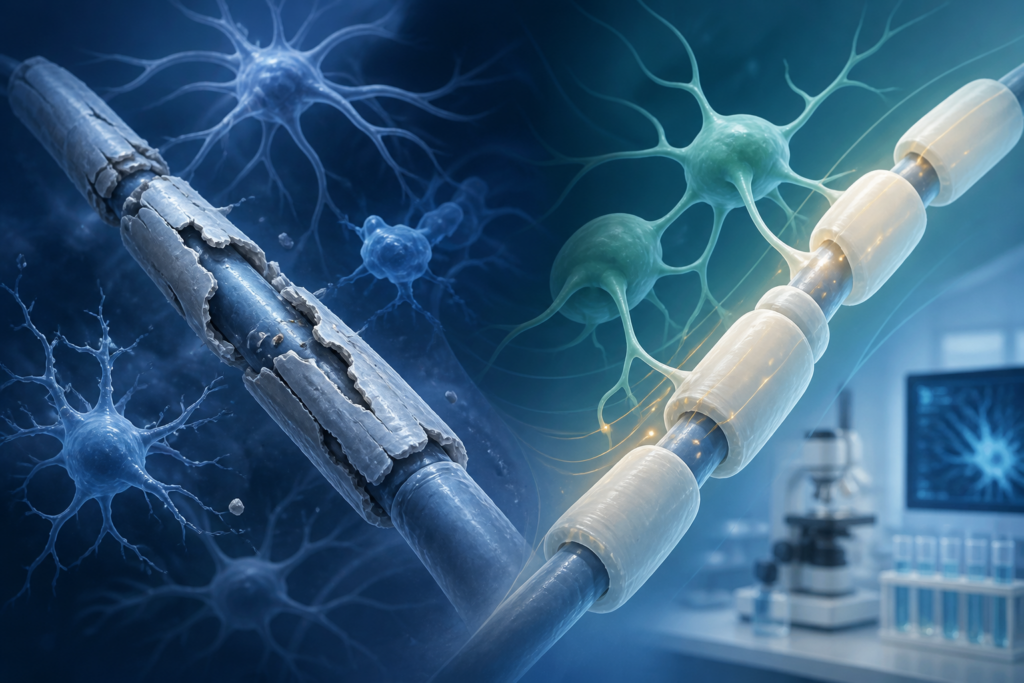
For patients researching stem cells for multiple sclerosis remyelination, this review examines whether signals released by MSCs can help repair damaged nervous tissue. It also evaluates whether similar signals may protect dopamine-producing neurons in Parkinson’s disease.
Four studies were evaluated. The human evidence includes a 54-patient MS trial and a 45-patient Parkinson’s trial. Both were randomized, double-blind, and placebo-controlled. In the MS trial, MSC-derived neural progenitors, which are MSCs processed to develop characteristics associated with nervous-system support, were injected into the fluid surrounding the spinal cord. The Parkinson’s trial used repeated intravenous MSC infusions.
Two animal studies provide evidence about how the treatments might work. One used a mouse model of long-term myelin damage, while the other used a toxin-induced rat model of Parkinson’s disease.
The animal studies examined myelin formation, myelin-producing cells, markers associated with dopamine-producing neurons, and motor behavior. The human trials measured disability, walking, bladder function, movement symptoms, imaging, biological markers, and safety. Neither human trial directly measured the restoration of myelin or dopamine-producing neurons. For that reason, greater weight was placed on the trials’ planned clinical outcomes than on animal findings, biomarkers, or results from smaller patient subgroups.
Biological Mechanism & Science
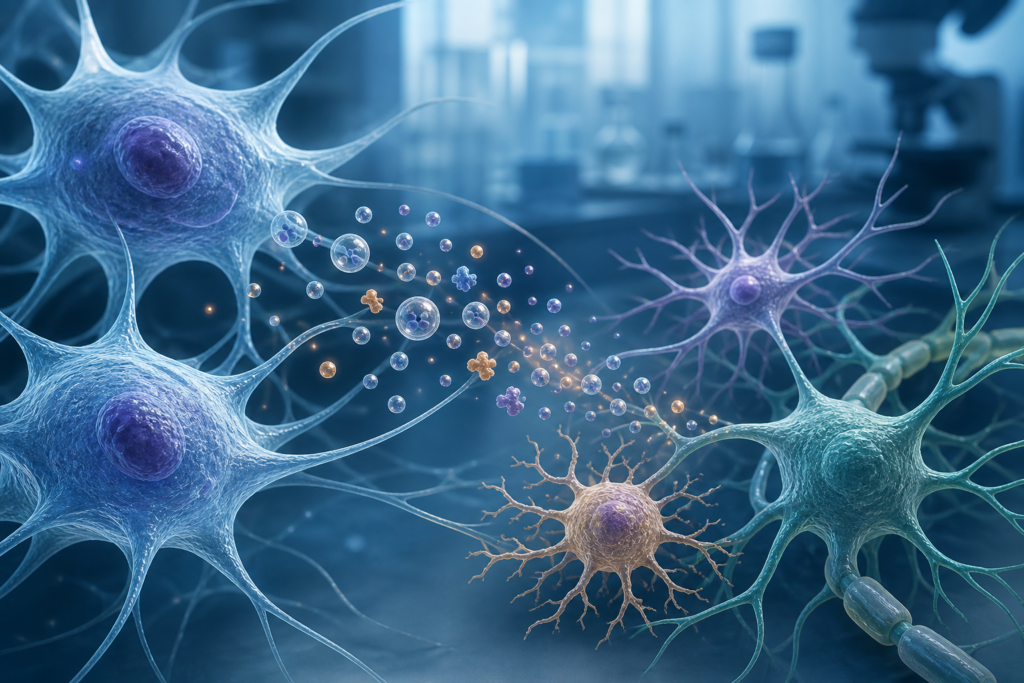
MSCs appear to work primarily as signaling cells rather than as replacement cells that become new neurons or directly rebuild myelin. In response to inflammation or injury, MSCs may release proteins and tiny cell particles that influence nearby cells. This mixture of released substances, called the secretome, may reduce inflammation, protect nerve cells, and encourage the brain’s existing repair cells to become active.
Jaramillo-Merchán and colleagues grafted bone-marrow-derived MSCs directly into areas of damaged myelin in mouse brains. The MSCs released several growth-supporting proteins. Oligodendrocyte progenitor cells, which are immature cells capable of developing into myelin-producing cells, moved toward the MSC graft. These cells matured, myelin-related measurements increased, and electrical signals traveled through nerve fibers more effectively. Because the MSCs did not appear to become oligodendrocytes or merge with existing cells, the researchers concluded that signaling was the most likely explanation.
The Harris MS trial offered more indirect evidence of biological activity in people. Treatment changed the levels of two substances in the fluid surrounding the brain and spinal cord. These changes might be connected to maturation of myelin-producing cells and reduced inflammation caused by immune cells in the brain. However, laboratory markers can suggest a biological effect without proving that new myelin formed or that patients experienced meaningful improvement.
In the Parkinson’s rat study, directly injecting the MSC secretome preserved more cells and nerve fibers with markers associated with dopamine production than transplanting MSCs themselves. This supports the idea that substances released by MSCs may be more important than the cells remaining in damaged tissue. However, cell source, manufacturing, dose, delivery method, and disease environment can all change what MSCs release and how those substances behave.
Key Findings & Patient Outcomes

In the Harris trial, the primary combined disability outcome improved in 33 percent of MSC-treated participants and 37 percent of placebo recipients. This difference was not statistically significant (p=0.666). Walking results favored treatment only in a smaller group of patients who required walking assistance. Because researchers examined this subgroup after reviewing the data, the result could have occurred by chance and requires confirmation.
Bladder, brain-volume, and biological findings were secondary or exploratory. Three patients who left the study had all received treatment, and their results were not included in the main effectiveness analysis. Their exclusion may have affected the comparison with placebo.
The Jaramillo-Merchán mouse study used several methods to evaluate repair, including tissue analysis, electron microscopy, and electrical measurements. However, some tests used very small groups, and the paper did not clearly report whether animals were randomly assigned or whether researchers assessing the results were unaware of treatment assignments. Direct injection into the brain also differs from most clinical delivery methods, and experimentally induced myelin damage does not reproduce the full complexity of MS.
In the Schiess Parkinson’s trial, the group receiving three MSC infusions met the study’s statistical definition of a treatment response. At week 62, however, average motor scores improved by 16.9 points in this group and 14.6 points with placebo. The average advantage over placebo was only 2.3 points, and the range of plausible results included the possibility that treatment made no difference. A group receiving placebo followed by two MSC infusions improved by only 3.9 points. The large placebo improvement and lack of a consistent pattern across treatment groups reduce confidence that MSCs caused the observed benefit.
Mendes-Pinheiro reported improved fine-motor performance and preservation of dopamine-related markers following secretome treatment in rats. However, another test of coordination and balance did not improve. Treatment groups included only four to six rats, and both the toxin model and direct brain delivery limit how confidently the results can be applied to people with Parkinson’s disease.
Clinical Data Summary
Stemedix Clinical Context
Reviewed by Dr. [Doctor Name], MD/DO
From a clinical perspective, the evidence supports continued investigation rather than treatment certainty. MSC signaling promoted remyelination in mice, but the human MS trial did not directly measure myelin repair and did not meet its primary endpoint. Its favorable walking result came from a smaller group identified after the data were reviewed. The bladder, imaging, and biological findings also require confirmation in larger studies.
The Parkinson’s evidence is similarly preliminary. The group receiving three infusions showed an encouraging statistical result, but its average improvement was only slightly greater than the improvement with placebo. Results from the group receiving two infusions were less favorable. The trial did not show that MSCs restored dopamine-producing neurons or slowed the progression of Parkinson’s disease.
Other controlled studies reinforce the need for caution. The 144-patient MESEMS trial did not show that intravenous MSCs reduced inflammatory brain lesions in MS. A separate 24-patient Parkinson’s trial published in 2026 found repeated MSC infusions feasible but did not demonstrate effectiveness on its main clinical outcome.
Future research should include larger multisite trials, consistently manufactured cell products, objective measures of myelin repair and nerve-cell damage, and longer follow-up. Until stronger clinical evidence is available, MSC treatment should remain investigational and should not replace established MS disease-modifying therapies, Parkinson’s medications, rehabilitation, or other physician-directed care.
Frequently Asked Questions
Can stem cell therapy help repair damaged myelin sheaths in multiple sclerosis?
Current evidence does not show that stem cell therapy repairs damaged myelin sheaths in people with MS. Research on stem cells for multiple sclerosis remyelination has produced encouraging findings in animal models, but human trials have not directly demonstrated new myelin formation. MSC therapy remains investigational.
What does current research show about MSC therapy for Parkinson’s disease?
Animal studies suggest that substances released by MSCs may help protect dopamine-producing neurons. Human trials have reported possible improvements in movement symptoms, but controlled results have been inconsistent and have not shown that MSCs restore dopamine-producing neurons or slow disease progression. MSC therapy remains investigational.
Are MSC treatments proven to be safe?
The human trials reported generally acceptable short-term tolerability. However, these studies were too small to rule out uncommon, delayed, or treatment-specific risks.
Regulatory Disclaimer
Stemedix provides this review for educational and informational purposes only and represents an academic commentary on published literature. The featured studies evaluate experimental procedures. Regenerative cell therapies discussed are non-FDA-approved treatments unless explicitly stated otherwise. Consult a board-certified physician before making medical decisions.
References
Harris VK, Stark J, Williams A, et al. Efficacy of intrathecal mesenchymal stem cell-neural progenitor therapy in progressive MS: results from a phase II, randomized, placebo-controlled clinical trial. Stem Cell Res Ther. 2024;15:151. doi:10.1186/s13287-024-03765-6. https://pubmed.ncbi.nlm.nih.gov/38783390/
Jaramillo-Merchán J, Jones J, Ivorra JL, et al. Mesenchymal stromal-cell transplants induce oligodendrocyte progenitor migration and remyelination in a chronic demyelination model. Cell Death Dis. 2013;4:e779. doi:10.1038/cddis.2013.304. https://pubmed.ncbi.nlm.nih.gov/23990019/
Schiess MC, Suescun J, Martinez-Lemus JD, et al. Allogeneic bone marrow-derived mesenchymal stem cells for Parkinson’s disease: a randomized trial. Mov Disord. 2025;40(12):2688-2699. doi:10.1002/mds.70028. https://pubmed.ncbi.nlm.nih.gov/40891094/
Mendes-Pinheiro B, Anjo SI, Manadas B, et al. Bone marrow mesenchymal stem cells’ secretome exerts neuroprotective effects in a Parkinson’s disease rat model. Front Bioeng Biotechnol. 2019;7:294. doi:10.3389/fbioe.2019.00294. https://pubmed.ncbi.nlm.nih.gov/31737616/
Uccelli A, Laroni A, Ali R, et al. Safety, tolerability, and activity of mesenchymal stem cells versus placebo in multiple sclerosis (MESEMS): a phase 2, randomised, double-blind crossover trial. Lancet Neurol. 2021;20(11):917-929. doi:10.1016/S1474-4422(21)00301-X. https://pubmed.ncbi.nlm.nih.gov/34687636/
Vij R, Kim H, Park H, Lotfi D, Cheng T, Chang D. Evaluation of multiple intravenous infusions of autologous adipose-derived mesenchymal stem cells in Parkinson’s disease: a randomized, double-blind clinical trial. Parkinsons Dis. 2026;2026:9934417. doi:10.1155/padi/9934417. https://pubmed.ncbi.nlm.nih.gov/42137372/
| Clinical Metric | Trial Specification |
|---|---|
| Study Type | Two randomized, double-blind, placebo-controlled human trials and two controlled animal studies |
| Participant Count | Harris MS trial N=54; Schiess Parkinson’s trial N=45; Jaramillo-Merchán study included 24 MSC-treated and 10 sham-treated mice; Mendes-Pinheiro treatment groups included 4 to 6 rats |
| Cell Type and Delivery | MSC-derived neural progenitors delivered into spinal fluid; bone-marrow MSCs delivered intravenously; direct brain delivery in both animal studies |
| Primary Outcomes | Disability, walking, motor symptoms, biological markers, myelin measures, electrical nerve conduction, dopamine-related markers, and safety |
| Evidence Summary | Possible biological effects without confirmed human remyelination, restoration of dopamine-producing neurons, or slowing of disease progression |