
Parkinson’s disease does not just affect movement. At its core, it disrupts the way brain cells communicate with each other. When the cells responsible for producing dopamine deteriorate, the signals that coordinate movement, mood, and cognitive function begin to break down. For many patients, that breakdown is gradual but progressive.
For the nearly one million Americans currently living with Parkinson’s, and the 1.2 million projected by 2030, managing those disrupted signals is a daily reality. Emerging research into regenerative therapy is offering a new lens through which scientists and patients are exploring what may be possible, and it is a focus area that Stemedix has built its work around.
This article breaks down how brain cell communication is affected in Parkinson’s disease and what current research suggests about how regenerative therapy may support that communication at a cellular level.
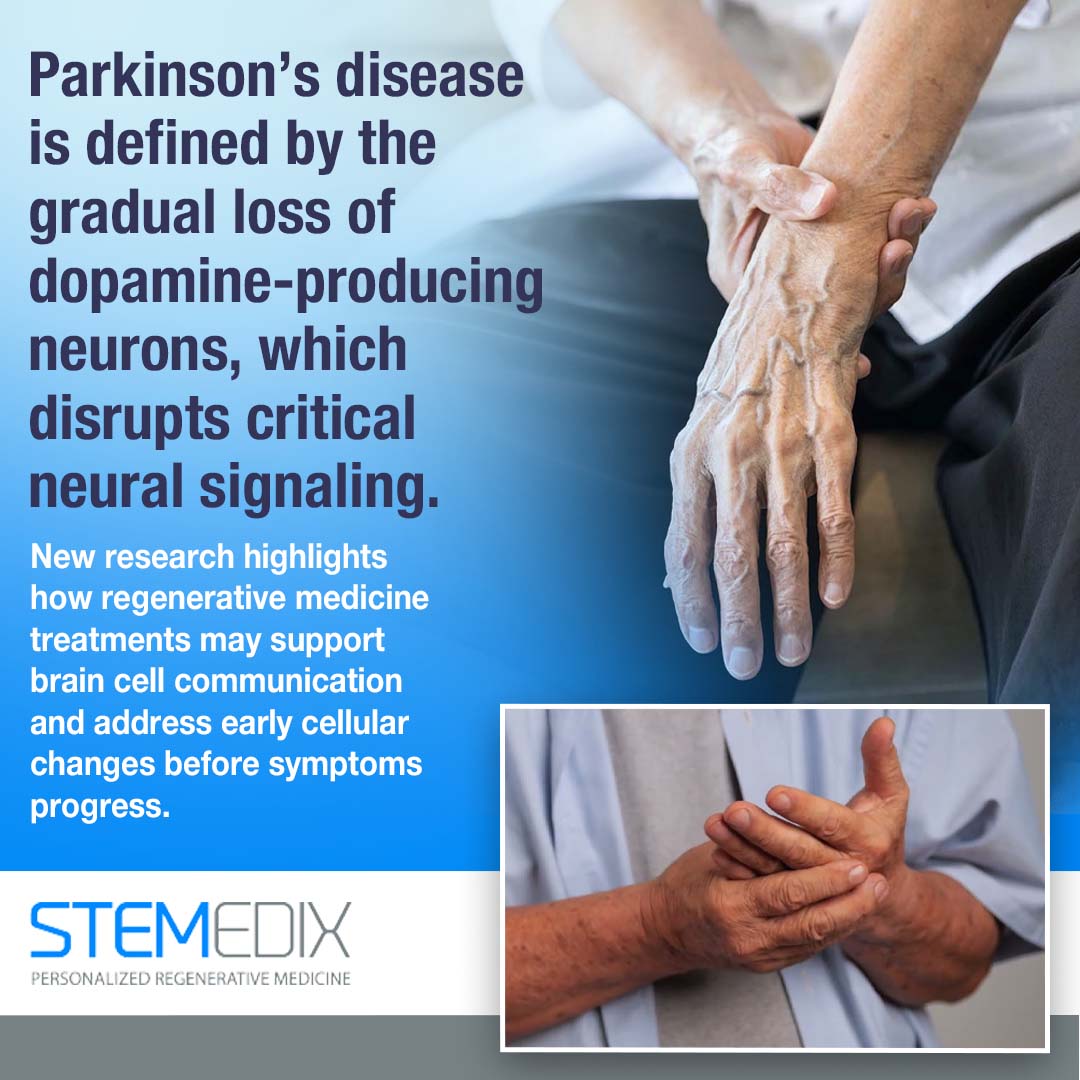
What Happens to Brain Cell Communication in Parkinson’s Disease?
To understand why communication breaks down, it helps to understand how it normally works.
How Healthy Brain Cells Communicate
Neurons, the cells in your brain, communicate by passing chemical signals across tiny gaps called synapses. These chemical messengers are called neurotransmitters. One of the most important neurotransmitters for movement and coordination is dopamine.
Dopaminergic neurons, located in a part of the brain called the substantia nigra, use dopamine to send signals throughout the brain’s movement-control network. When you reach for a glass, take a step, or write a sentence, dopamine is helping to coordinate those actions.
What Parkinson’s Does to That System
In Parkinson’s disease, the dopamine-producing neurons in the substantia nigra progressively degenerate. According to the National Institute of Neurological Disorders and Stroke, by the time symptoms appear, most people have already lost 60 to 80% or more of those dopamine-producing cells.
The result is a significant breakdown in cell-to-cell communication:
- Movement signals become imprecise or delayed
- Tremors, stiffness, and slowness of movement develop
- Non-motor symptoms such as mood changes and cognitive difficulties can emerge
A study published in Frontiers in Aging Neuroscience found that in Parkinson’s patients, the overall quantity of intercellular communication in the substantia nigra was decreased, while certain communication pathways became abnormally strengthened. This imbalance between different communication signals is believed to contribute to the disease’s progression.
The Role of Serotonin
Dopamine is not the only neurotransmitter involved. Research also points to serotonin loss as a contributing factor in Parkinson’s. Serotonin influences mood, sleep, and cognitive function. Its decline may explain why many people with Parkinson’s experience symptoms beyond movement, including depression, sleep disturbances, and memory challenges.
What makes this particularly significant is that serotonin loss appears to continue even after dopamine-focused therapies are applied. This means that for a number of patients, addressing dopamine alone may not be enough to support overall quality of life. Understanding the full picture of neurotransmitter disruption is an important part of exploring broader approaches to symptom management.
What Is Regenerative Therapy?
Regenerative medicine treatment refers to therapies that work with the body’s own biological systems to potentially repair or replace damaged cells and tissues. These therapies use regenerative biological products that may have the ability to:
- Differentiate into various cell types, including those found in the brain
- Secrete molecules that support cell communication and reduce inflammation
- Modulate the immune response in areas of cellular damage
In the context of Parkinson’s disease, regenerative therapy is being studied for its potential to address the underlying cellular damage rather than only managing surface-level symptoms.
It is important to note that regenerative medicine is still considered an experimental procedure. Patients are encouraged to review research carefully, consult with their existing medical providers, and maintain realistic expectations when exploring this option.
How Regenerative Therapy May Support Brain Cell Communication
Targeting Dopamine Neuron Loss
One of the most studied applications of regenerative therapy for Parkinson’s involves mesenchymal stromal cells (MSCs), a type of regenerative biological cell derived from sources such as bone marrow. Research has shown these cells may have the ability to differentiate into dopamine-producing neurons.
A phase IIA clinical trial investigated intravenous infusions of bone marrow-derived MSCs as a potential disease-modifying therapy for Parkinson’s. According to the American Parkinson Disease Association, the study was double-blind, randomized, and enrolled 45 people with Parkinson’s. It built on a prior phase I study of 20 people that found the treatment was safe, well tolerated, and correlated with a reduction in Parkinson’s symptoms, with the highest dose showing the most significant effect.
Reducing Neuroinflammation
Chronic brain inflammation is one of the key drivers behind Parkinson’s disease progression. Inflammation damages brain tissue, disrupts cell signaling, and accelerates neuron loss.
MSCs can modulate the immune response and migrate to injury sites. Once there, they secrete anti-inflammatory molecules and growth factors that interact with surrounding cells. This process may allow damaged brain cells to regenerate more effectively.
By reducing inflammation, regenerative biological products may help preserve existing dopamine neurons and support the conditions needed for healthier cell-to-cell communication.
Supporting Serotonin Neuron Regeneration
Beyond dopamine, research indicates that regenerative medicine therapy may also support serotonin neuron regeneration. This is a meaningful area of study given the role serotonin plays in mood, sleep, and cognitive function in Parkinson’s patients.
For many individuals, the non-motor symptoms of Parkinson’s, such as mood shifts, fatigue, and disrupted sleep, can be just as difficult to manage as the physical ones. Addressing both dopamine and serotonin pathways could potentially support a broader range of symptoms than dopamine-focused approaches alone.
The Role of Exosomes in Cell Communication
One of the more recent areas of research involves exosomes, which are tiny vesicles secreted by cells that play a critical role in cell-to-cell communication. MSC-derived exosomes are believed to be responsible for a significant portion of the regenerative effects observed in studies. These exosomes carry proteins, genetic material, and signaling molecules that may influence how neighboring cells behave and communicate.
This paracrine effect, where regenerative biological products communicate with nearby damaged cells without necessarily replacing them, represents a promising avenue for supporting neural communication in Parkinson’s disease.
Who May Be a Candidate?
Regenerative therapy for Parkinson’s disease is not a one-size-fits-all solution. Candidacy is determined on an individual basis through a thorough review of each patient’s medical history, current condition, and prior diagnoses.
At Stemedix, we do not diagnose conditions. Our team works with patients who have already received a Parkinson’s diagnosis and are seeking an alternative option to support their ongoing care. Patients are asked to share existing medical records, blood work, and imaging results. If records are too outdated, the team can help coordinate the process of gathering updated documentation by assisting with a medical records release.
Once records are reviewed, a board-certified physician assesses whether there may be a potential benefit. If candidacy is confirmed, a personalized treatment plan is developed based on the individual’s specific condition and health profile. No two patients receive the same plan.
The first step is connecting with a dedicated Care Coordinator, who will walk you through what to expect and help determine whether regenerative therapy may be a suitable option for your situation.
Accessing Regenerative Therapy in Saint Petersburg, FL
For those exploring regenerative therapy in Saint Petersburg, FL, the Bayfront Medical Plaza location offers a fully supported, patient-centered experience tailored to each individual’s needs.
Traveling for medical care comes with its own set of considerations. At Stemedix, our team understands that many patients arriving from out of town require more than just a clinical appointment. Support services are available to help make the experience as smooth as possible, including:
- Airport and appointment transportation
- Accommodation assistance
- Wheelchair, walker, and shower chair support
- A dedicated Care Coordinator throughout the entire process
Patients do not need to navigate any part of this journey alone. From the initial record review to post-visit follow-up, our team is structured to provide guidance at every stage. Board-certified physicians review each patient’s case, assess potential benefit candidacy, and design a personalized treatment plan if the patient is approved.
Moving Forward: What to Consider
If you or someone you love is living with Parkinson’s disease and exploring alternative options beyond what is currently in place, here are some practical points to keep in mind:
Understand the research: Regenerative medicine treatment is still in the research phase for many conditions. Review studies, ask questions, and make informed decisions with realistic expectations.
Work with your current care team: Regenerative therapy is not a replacement for your primary physician or neurologist. The goal is to provide access to regenerative therapy as a complementary option, not as a primary course of treatment.
Start with a consultation: Speaking with a Care Coordinator is the first step. There is no obligation involved. The goal is to help you understand whether this path may be appropriate for your specific diagnosis and health profile.
Get your records in order: Having updated medical records, imaging, and blood work ready can help streamline the evaluation process. If existing records are older than what is needed, our team can assist in coordinating updated documentation so the review can move forward without unnecessary delays.
How Stemedix Can Support Your Parkinson’s Journey
Parkinson’s disease disrupts the brain’s communication network in ways that go far beyond movement. As researchers continue to study how regenerative biological products interact with damaged neurons, the science around brain cell communication and neurological recovery is advancing.
Regenerative therapy is not a cure for Parkinson’s disease. No such cure currently exists. What it represents is an alternative avenue of exploration for those seeking to address the cellular foundations of the condition and support a better quality of life.
Stemedix supports individuals exploring regenerative therapy in Saint Petersburg, FL, through structured medical record review and coordinated patient guidance. If you are reviewing regenerative treatment options, you can connect with our team to begin the process and submit your medical records for evaluation.
Contact us today at (727) 456-8968 or email yourjourney@stemedix.com to request information or start your record review. Our team will guide you through the next steps and help organize your medical documentation for treatment consideration.