PRP Therapy

Regenerative Medicine for PRP Therapy

Regenerative Medicine, also known as PRP therapy, is an alternative option to help manage the symptoms of musculoskeletal and joint pain.

Contact a Care Coordinator

YOUR REGENERATIVE JOURNEY CAN BEGIN

From issues like tendonitis to arthritis, there are many conditions that are notoriously challenging to treat through standard therapies. To address these and other concerns, the medical community has recently begun leveraging powerful resources found within patients themselves: plasma. Platelet-rich plasma (PRP) is a substance featuring concentrated platelets and proteins which are derived from whole blood.

Our blood naturally contains plasma, a liquid with platelets, which contain growth factors to help support cellular development and healing. When the platelets are isolated and their concentration is increased, their growth factors are amplified by five to ten times. This concentrated solution holds tremendous potential for promoting healing across a range of conditions.

Musculoskeletal injuries are among the most common culprits behind persistent discomfort. These, along with chronic conditions such as arthritis, are well-suited for PRP Therapy. Such conditions don’t always respond well to traditional treatments but continue to produce frustrating symptoms for those who experience them. PRP injections are thus a promising minimally invasive solution to help patients improve their quality of life.

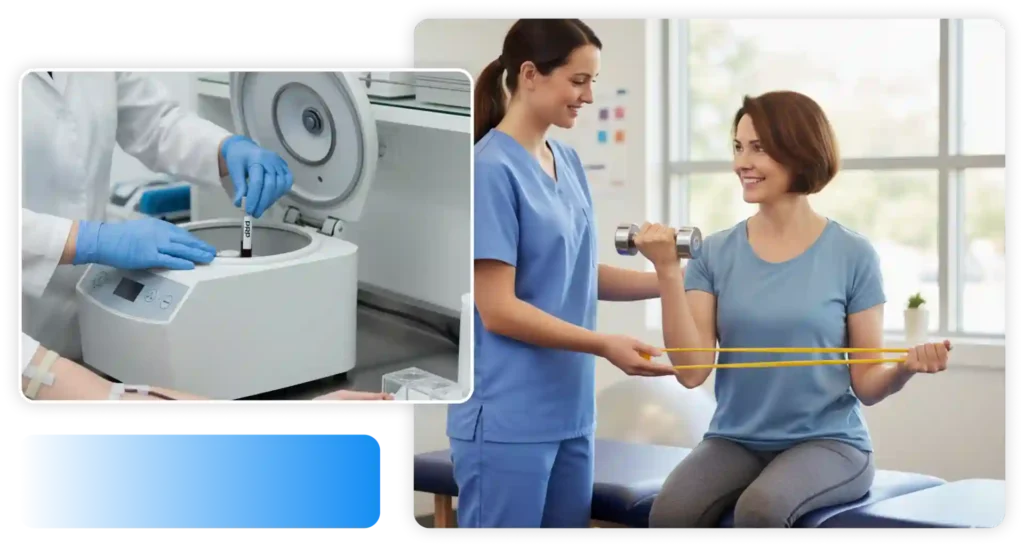
PRP therapy is often a successful treatment to help those experiencing symptoms of arthritis and soft tissue injury. However, depending on the severity of the condition, PRP may not be enough. In these cases, Stem Cells, Exosomes, or a combination of both therapies may be the next step needed to potentially help eliminate pain as well as initiate tissue regeneration and strength to the targeted areas.

Studies have shown the following potential symptom improvements:

  • Decrease or Elimination of Pain
  • Reduction of Medication Intake
  • Promotes Faster Rate of Healing
  • Slower or Stopped Rate of Cartilage Destruction
  • Supports Long Term Healing
  • Stimulates Cell Growth and Cell Repair at Injury site
  • Safe and Low Risk Procedure

Regenerative Medicine is still considered an experimental procedure and not approved by the FDA. Patients must consider realistic expectations in their research and possible therapy options.

Speak with a Care Coordinator today for a more accurate assessment of your condition and therapy options.

Speak with a Care Coordinator

Patient Testimonials

Please see the comments and personal video testimonies on our website to see our patients’ experience and their personal journey to wellness with Stemedix.

How Stemedix Helps You Heal

Professional Medical Care

Our Board-Certified Physicians specialize in regenerative medicine. They stay abreast of the latest developments in stem cell research. Each patient is screened and reviewed before being approved for therapy.

Advanced Therapy

Each patient is thoroughly reviewed to ensure their safety for treatment. The physicians will then determine potential benefit candidacy. If approved, a customized treatment plan is offered for the patient.

Specialized Care

Stemedix can help coordinate patients with necessary wheelchair transportation, medical equipment, and Care Giving services as needed during their stay. Your Care Coordinator is available for questions and assistance.

Latest Articles on Stem Cell Therapy

Scientist viewing fluorescent microscopy images of cells with red-stained cytoskeletons and blue nuclei on a computer monitor

The Science of Dopamine Restoration Through Regenerative Therapy

Dopamine supports movement, focus, and motivation by enabling communication between nerve cells in the brain. Changes in dopamine activity are linked with several neurological conditions that affect daily function and quality of life. Regenerative therapy is being explored in clinical research as a way to support the biological environment connected to these pathways. In regenerative…

Stem Cell Therapy and ALS: Exploring Emerging Regenerative Medicine Research

Regenerative Medicine and ALS: Exploring Emerging Regenerative Medicine Research

Amyotrophic lateral sclerosis (ALS), also known as Lou Gehrig’s disease, is a progressive neurodegenerative disorder that affects nerve cells responsible for controlling voluntary muscle movement. Over time, the disease causes degeneration of motor neurons in the brain and spinal cord, leading to muscle weakness, loss of mobility, difficulty speaking and swallowing, and eventually respiratory complications.…

Mesenchymal Stem Cell-Derived Neural Progenitors and Multiple Sclerosis: A New Direction in Regenerative Medicine Research

Mesenchymal Stem Cell-Derived Neural Progenitors and Multiple Sclerosis: A New Direction in Regenerative Medicine Research

Multiple sclerosis (MS) is a chronic neurological disease in which the immune system attacks the protective myelin sheath surrounding nerve fibers in the brain and spinal cord. Over time, this damage disrupts communication between the brain and body, leading to symptoms such as fatigue, weakness, balance problems, muscle stiffness, numbness, and cognitive difficulties. In progressive…

Read all blogs

Forward-Thinking Medicine for Regenerative Medicine

Contact us today and let Stemedix provide professional service accompanied by one of our Care Coordinators to ensure you have the best experience possible!

Contact a Care Coordinator
Subscribe To Our Newsletter

Join our mailing list to receive the latest news and updates from our team.

"*" indicates required fields

This field is for validation purposes and should be left unchanged.