
Direct answer: Before a spinal fibrin procedure, ask for the exact product and route, evidence relevant to your diagnosis, clinician credentials, candidacy criteria, risks, alternatives, total costs, aftercare, and the plan for complications or no improvement.
Fibrin is a category, not a complete product description. “Intradiscal” means delivery into a disc, while “intra-annular” refers to its outer ring. Studies of one product, route, or patient group may not apply to another.

Start With the Exact Product and Route
Ask the clinician to put the following in writing:
- The exact product name and manufacturer
- Whether it is prepared on-site or supplied as a finished product
- The proposed route and location of administration
- The imaging guidance and sedation plan
- The number of levels or sites to be treated
- The follow-up schedule and emergency contact process
Request the studies the clinician relies on, then compare their details with the proposed treatment:
- Did participants have the same diagnosis and similar symptoms?
- Was the same product, route, and technique studied?
- Was there a comparison group?
- How many participants completed follow-up?
- Were pain, function, medication use, and quality of life measured?
- How long did any reported improvement last?
- What adverse events occurred?
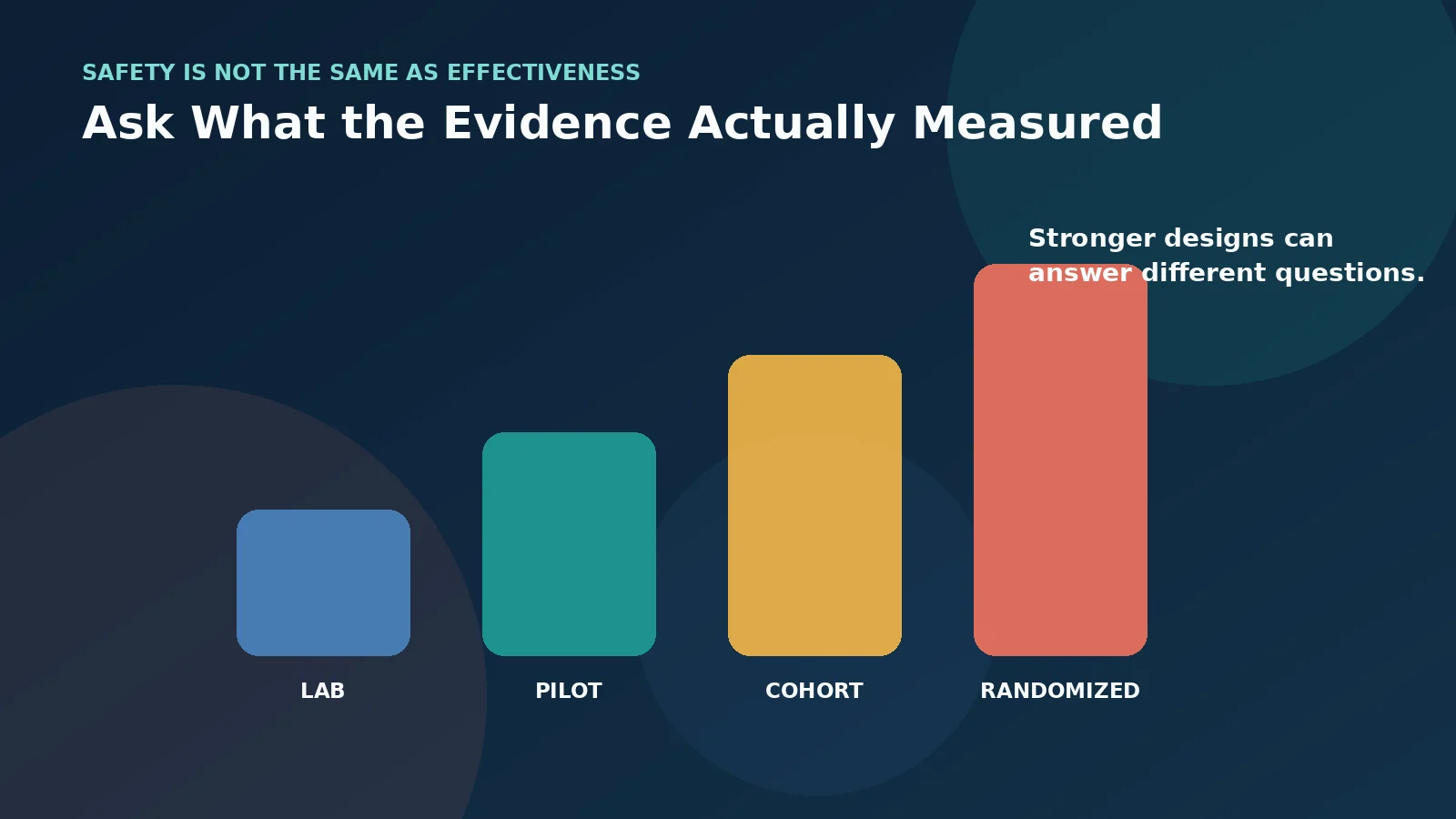
A January 2026 VA systematic review found the evidence limited in quantity and quality. It reported that one studied intradiscal fibrin system did not reduce pain intensity or interference compared with saline, while evidence for an intra-annular system remained very uncertain. The review also warned that findings may not apply to different products, diagnostic criteria, patients, or clinicians.[1]
Earlier research included a 15-person, nonrandomized pilot study, while a later analysis of randomized-trial data found no outcome difference between investigational intradiscal agents and saline at 12 months.[2][3]
A larger intra-annular cohort reported improvement, but it was a single-center, nonrandomized registry analysis. The VA review noted incomplete follow-up and potential conflict-of-interest concerns.[1][4]
Confirm the Clinician’s Credentials and Your Candidacy
Ask who will perform each important step and verify an active license, relevant board certification, procedure-specific training, and experience with the exact technique.
The evaluation should explain why the suspected pain source is a disc rather than another condition. Ask what examination, imaging, and diagnostic criteria support candidacy, what excludes you, and whether an independent spine specialist agrees.
Review Risks, Alternatives, Costs, and Aftercare
Do not settle for “minimally invasive” as a complete risk discussion. Ask about infection or discitis, bleeding, nerve injury, pain flare, allergic reactions, sedation or contrast risks, and no improvement. A small fibrin pilot reported adverse events in 9 of 15 participants, including procedure- or product-related muscle spasms and one case of discitis.[2] Risks may vary by product and technique.
Compare those risks with alternatives such as observation, rehabilitation, medication management, other injections, behavioral pain care, another opinion, surgery when indicated, or participation in an appropriate clinical trial.
Obtain written aftercare instructions covering restrictions, medications, expected symptoms, follow-up, and after-hours help.
Pre-Procedure Checklist
Do not proceed until you can answer yes to each item:
- I know the exact product, route, and technique.
- I understand why my diagnosis and records support candidacy.
- I reviewed evidence that matches the proposed procedure.
- I understand the evidence limitations and possibility of no improvement.
- I received a clear explanation of risks and alternatives.
- I verified the clinician’s credentials and procedure-specific experience.
- I received the full cost estimate and aftercare plan.
- I know whom to contact for urgent concerns.
What Are the Evidence Limitations?
Current evidence does not establish that spinal fibrin products, routes, or protocols are equivalent. Studies are few, and some are small, uncontrolled, single-center, or affected by incomplete follow-up. Results from selected patients and experienced clinicians may not generalize to routine practice.[1] No outcome can be promised.
Frequently Asked Questions
Does research on one fibrin product apply to every spinal fibrin procedure?
No. Product formulation, route, technique, diagnostic criteria, and patient selection can differ. Ask the provider to explain why the cited study is relevant to the exact procedure being proposed.
Does “minimally invasive” mean low risk?
No. The phrase describes how a procedure is performed, not whether it is appropriate or risk-free. Ask for procedure-specific risks, complication rates, aftercare instructions, and the plan if symptoms worsen.
Prepare for a More Informed Consultation
A Care Coordinator can help you organize records and prepare questions for a clinician. A consultation should clarify the exact product and route, candidacy, evidence limitations, alternatives, costs, and safety plan; it should not guarantee a result. Call 800-531-0831 or visit the Stemedix contact page (https://stemedix.com/contact/) to discuss the evaluation process and what information to bring.
Sources
[1] https://www.hsrd.research.va.gov/publications/management_briefs/default.cfm?ManagementBriefsMenu=eBrief-no244 — Efficacy and Safety of Fibrin Intervertebral Injections for Back and Neck Pain: A Systematic Review
[2] https://pubmed.ncbi.nlm.nih.gov/24152079 — Intradiscal Injection of Fibrin Sealant: Prospective Multicenter Pilot Study
[3] https://pubmed.ncbi.nlm.nih.gov/33047622 — Is There Clinical Improvement Associated With Intradiscal Therapies?
[4] https://pubmed.ncbi.nlm.nih.gov/39621982 — Long-term Investigation of Annulargrams and Intra-annular Fibrin
Related Treatment Pages