
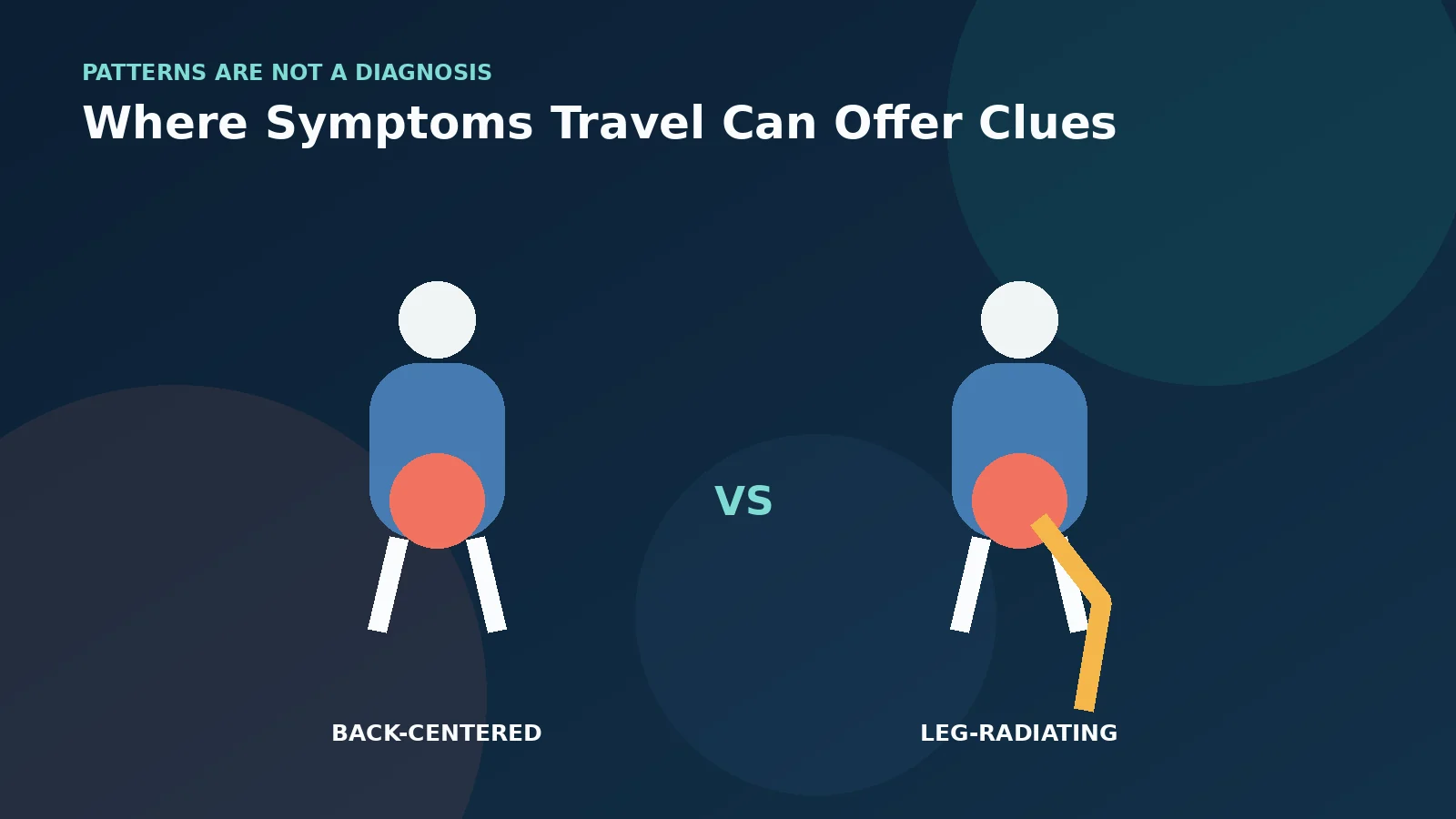
Discogenic pain is back pain thought to arise from an intervertebral disc, while sciatica usually describes leg-dominant pain associated with irritation of a spinal nerve root. Discogenic pain is generally felt in the low back and may refer into the buttocks or thighs; radicular pain is more likely to feel shooting, electric, burning, or sharp as it travels into the leg.[1][2]
What does discogenic pain usually feel like?
Discogenic pain is a form of axial pain, meaning symptoms are centered mainly in the back rather than following a nerve into the leg. It may feel like a deep midline ache, sometimes extending into the buttocks or thighs. Sitting, bending, lifting, twisting, or coughing may aggravate it, but these patterns are only clues.[1]
A disc can show degeneration, height loss, a bulge, or an annular fissure without being the cause of pain. Discogenic pain therefore cannot be diagnosed from symptoms or an MRI report alone; the history, examination, neurologic findings, imaging, and alternatives must fit together.[4][5]
Is discogenic pain the same as sciatica?
No. Sciatica is a broad, commonly used label for pain traveling from the back or buttock into the leg. More precise terms are radicular pain and radiculopathy. Radicular pain is linked to irritation or inflammation around a nerve root and is often described as shooting, electric, burning, or stabbing. Radiculopathy means a nerve root is not functioning normally, which may produce measurable weakness, sensory loss, or altered reflexes; pain may or may not be present.[2]
A herniated disc can cause both conditions at once: the disc itself may contribute to axial back pain, while nearby nerve-root irritation produces radicular leg pain. Spinal stenosis can also cause leg symptoms; readers can learn more in Stemedix’s guide to spinal stenosis (https://stemedix.com/what-is-spinal-stenosis/).
How do the common sources of lower back pain compare?
| Pain type | Structure or mechanism considered | Common pattern that may raise suspicion |
|---|---|---|
| Discogenic | Intervertebral disc | Central low-back ache; may refer to buttock or thigh; often aggravated by sitting or bending |
| Radicular / “sciatica” | Irritated or compressed nerve root | Shooting, electric, burning, or sharp pain into the leg; tingling or numbness may occur |
| Vertebrogenic | Vertebral endplates and basivertebral nerve | Midline axial pain sometimes associated with endplate changes called Modic changes |
| Facet-related | Small joints at the back of the spine | One- or two-sided back pain, often worse with extension, rotation, or prolonged standing |
| Sacroiliac (SI) joint | Joint between the sacrum and pelvis | Pain near one upper buttock or the “dimple” area; several SI provocation tests may reproduce it |
| Muscular / myofascial | Muscles and fascia | Local tenderness, tightness, spasm, or pain reproduced by pressing or using the involved muscle |
These patterns overlap. Somatic referred pain from a disc, facet, SI joint, or muscle can spread into the buttock or thigh without being nerve-root pain. Vertebrogenic pain may resemble discogenic pain, and Modic changes on MRI do not independently establish that an endplate is the pain source. The published clinical description of vertebrogenic pain remains less developed than many patients may assume.[3]
How do clinicians evaluate where back pain may be coming from?
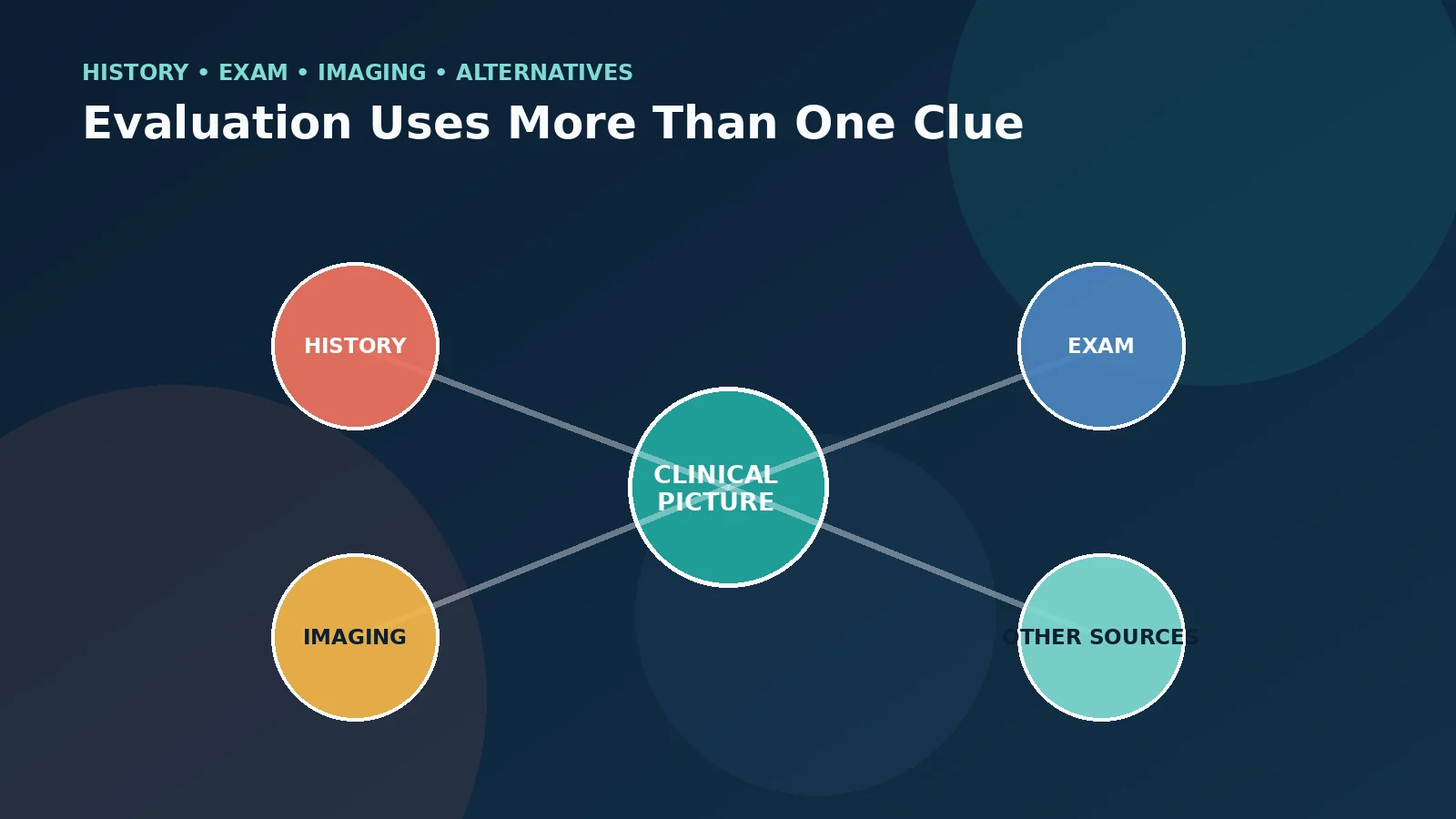
Evaluation begins with the history and a physical and neurologic examination. A clinician may assess strength, sensation, reflexes, walking, spinal movement, nerve-tension signs, focal tenderness, and SI-joint maneuvers while considering nonspinal causes.
No single symptom or office maneuver reliably identifies every pain source. A 2023 review found that certain findings can change the probability that pain comes from the disc, SI joint, or facet joint, but the reference tests have limitations and much of the research involved specialty settings.[4]
Imaging may be appropriate when red flags are present, neurologic problems are progressing, symptoms persist despite appropriate care, or the result would change management. For uncomplicated low-back pain, routine early imaging is generally not recommended. MRI can reveal anatomy, but it cannot show pain itself, and common degenerative findings may be incidental.[5]
Which back-pain warning signs need prompt medical attention?
Seek emergency care now for new urinary retention or overflow incontinence, loss of bowel control, numbness in the groin or saddle area, or bilateral or progressive leg weakness. These can be signs of cauda equina syndrome or another severe neurologic problem.[5]
Prompt medical evaluation is also important after significant trauma, or when back pain occurs with fever or systemic illness, a history of cancer, unexplained weight loss, immunosuppression, intravenous drug use, osteoporosis, or prolonged corticosteroid use. One feature alone does not confirm a serious condition, but the overall pattern may require timely examination and imaging.[5]
What should you do if the source of your back pain is unclear?
Start with a qualified clinician who can evaluate the whole picture rather than treating an MRI label. Stemedix provides information about its pain-management services (https://stemedix.com/pain-management/) and evaluation process.
A Stemedix Care Coordinator can explain records requirements and help arrange a consultation. Only a licensed clinician can diagnose the likely source and discuss options after an individual assessment. A consultation does not establish candidacy for, or guarantee, a fibrin, regenerative, or other procedure. Call 800-531-0831 or visit the Stemedix pain-management page (https://stemedix.com/pain-management/) to learn more.
Frequently Asked Questions
Can discogenic pain travel into the leg?
It can refer into the buttock or thigh. Electric or shooting pain farther down the leg raises greater concern for radicular pain, but location alone is not diagnostic.[1][2]
Does a bulging or degenerative disc prove the disc is painful?
No. Disc degeneration and bulges are common imaging findings, including in people without back pain. The finding must be interpreted alongside symptoms, examination results, and other possible causes.[5]
Can someone have discogenic pain and sciatica together?
Yes. A damaged or herniated disc may be associated with axial back pain while also irritating a nerve root and producing radicular leg pain. A clinician should evaluate each component rather than assuming every symptom has one source.
Sources
[1] https://pmc.ncbi.nlm.nih.gov/articles/PMC10882106 — Acute back pain: Clinical and radiologic diagnosis—WFNS spine committee recommendations
[2] https://pmc.ncbi.nlm.nih.gov/articles/PMC10348639 — Recommendations for terminology and identification of neuropathic pain in spine-related leg pain
[3] https://pmc.ncbi.nlm.nih.gov/articles/PMC9297155 — Vertebrogenic Pain: A Paradigm Shift in Diagnosis and Treatment of Axial Low Back Pain
[4] https://doi.org/10.1016/j.eclinm.2023.101960 — Low back pain of disc, sacroiliac joint, or facet joint origin: a diagnostic accuracy systematic review
[5] https://acsearch.acr.org/docs/69483/narrative — ACR Appropriateness Criteria: Low Back Pain
Related Treatment Pages