
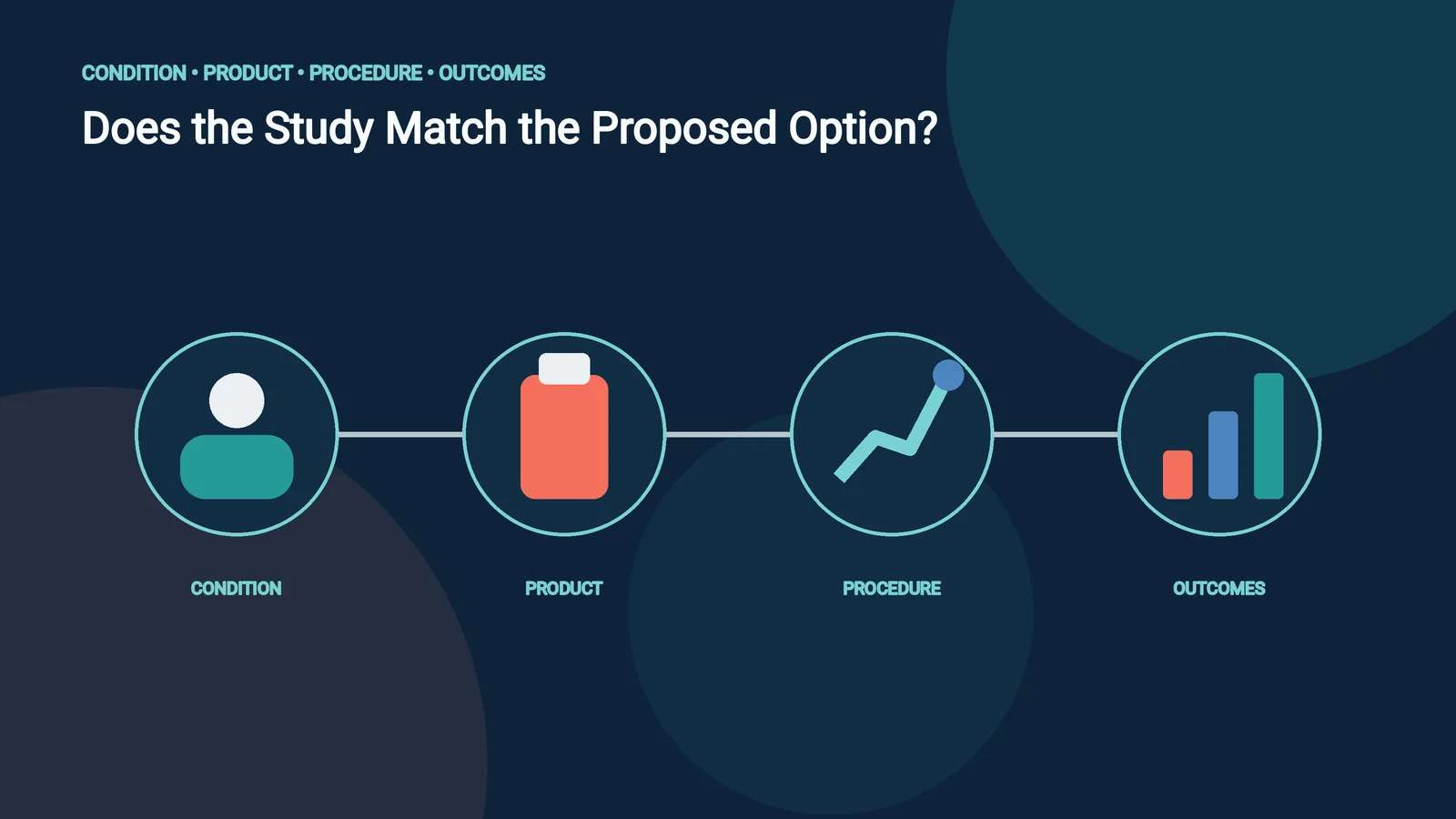
Direct answer: Focus on human research that closely matches the condition, product, procedure, and outcomes being discussed. Then examine the study design, participant count, comparison group, follow-up period, adverse events, limitations, and financial disclosures. A trial listing or one positive paper does not guarantee that an option will help a particular patient.
What Makes a Study Relevant to a Patient’s Decision?
Regenerative medicine is a broad field. Research involving one cell source, preparation method, route, dose, diagnosis, or patient group may not apply to another. Before relying on a paper, identify who participated, what they received, what it was compared with, which outcomes were measured, and how long participants were followed.
The closer those details are to the option being considered, the more directly relevant the study may be. Research involving a different condition or procedure can still provide context, but it should not be presented as proof of the same result.
Which Study Designs Answer Which Questions?
Laboratory and animal studies can explore biological mechanisms, but they cannot establish how well an intervention works in people. Case reports and small pilot studies may identify early signals or practical concerns, yet they cannot reliably separate a treatment effect from natural recovery, expectations, or other care.
Controlled human studies can provide stronger evidence when groups are comparable and outcomes are measured consistently. Randomization may reduce selection bias. Systematic reviews can summarize several studies, but their conclusions remain limited by the quality and consistency of the included research. No single study design removes every uncertainty.
Are the Study Outcomes Meaningful?
A paper may report changes in imaging, laboratory markers, inflammation, or another biological measure. Those findings can be useful, but they are not always the same as noticeable improvement in pain, mobility, breathing, daily function, medication use, or quality of life.
Patients should ask whether the research measured outcomes that matter for the condition being discussed. The size of the change also matters. A statistically significant difference may still be too small to represent a meaningful clinical benefit.

What Limitations Should Patients Check?
Read beyond the title and abstract. Important limitations may include a small sample, no comparison group, inconsistent diagnostic criteria, self-reported outcomes, short follow-up, missing participants, selective reporting, or results from only one treatment center.
Funding and author disclosures should also be reviewed. A financial relationship does not automatically invalidate research, but it should be considered alongside the methods, independent replication, and availability of complete results.
Research Checklist Before a Consultation
Identify the exact diagnosis or condition being discussed.
Request the human studies most relevant to that exact option.
Compare the participants, intervention, outcomes, and follow-up with your situation.
Review adverse events, limitations, funding, and author disclosures.
Discuss standard care, other reasonable options, and whether another medical opinion would help.
Frequently Asked Questions
Does a clinical trial listing prove an intervention works?
No. A trial registry describes a study and may list its sponsor, design, eligibility rules, locations, and status. The listing alone does not establish safety, effectiveness, or relevance to an individual patient.
Is one positive study enough?
Usually not. Confidence increases when well-designed studies produce consistent findings and independent researchers can reproduce the results. A single small or uncontrolled study is better viewed as one part of the evidence.
Should patients rely only on the abstract?
No. The full paper may contain important information about participant selection, methods, missing data, adverse events, limitations, and conflicts that does not appear in the abstract.
Speak With a Stemedix Care Coordinator
A Stemedix Care Coordinator can explain the records-review process and help patients prepare questions for a qualified provider. Individual candidacy and clinical recommendations require medical review, and outcomes cannot be guaranteed.
Call 800-531-0831 or visit the Stemedix regenerative medicine page to learn more.
Sources Consulted
About ClinicalTrials.gov — National Library of Medicine
PubMed Help — National Library of Medicine
Know the Science — National Center for Complementary and Integrative Health
CONSORT Statement — Reporting guidance for randomized trials
Related Treatment Pages